Product
Everything an agency runs on, in one system.
Not a dashboard over somebody else's data, and not a billing system. The operational record you run on — and answer a licensing review from.
The workflow01
One connected workflow — from assignment to audit.
The platform is valuable because the steps are joined. Each one produces the next, and every screen below is the real product.
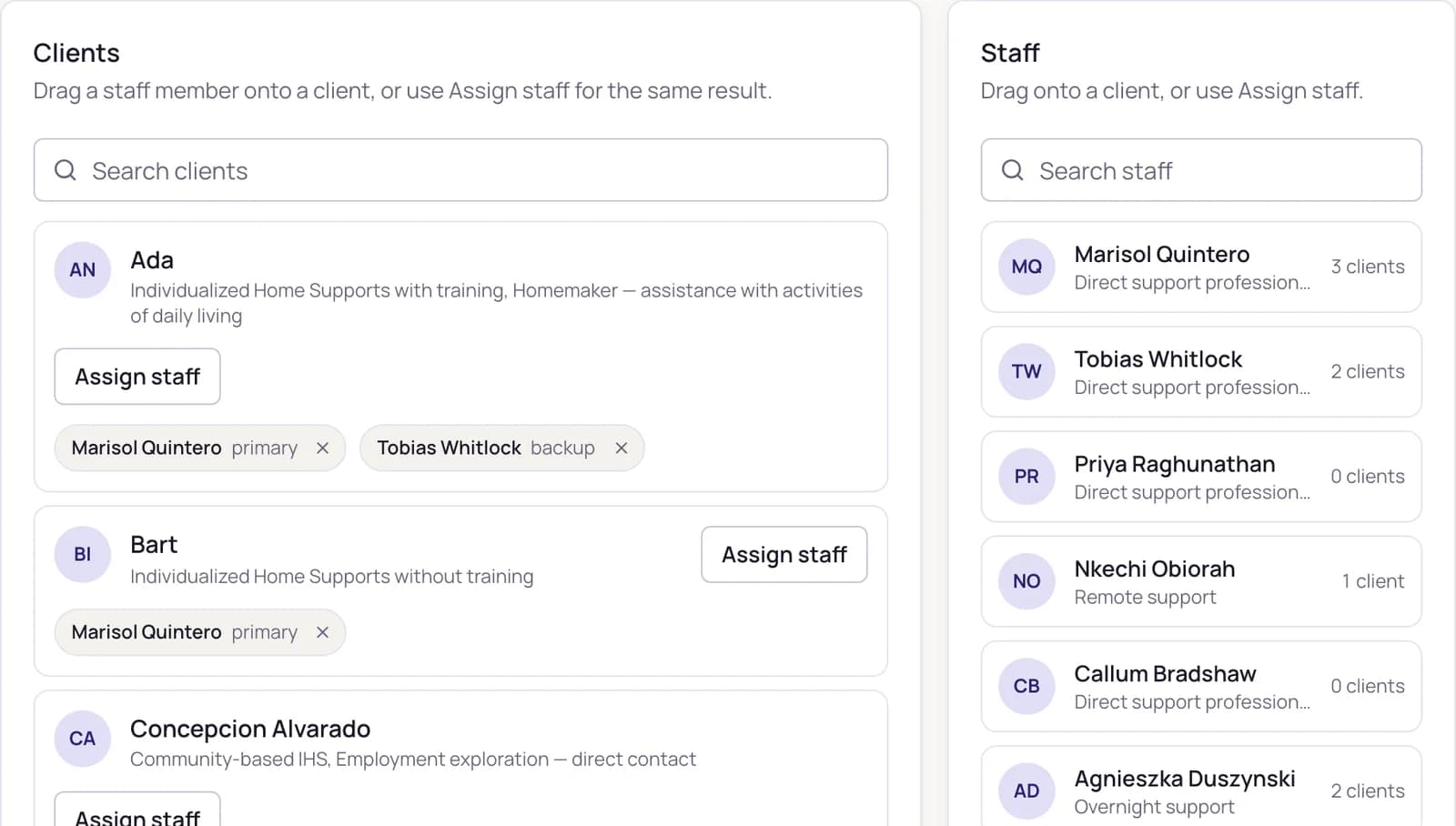
Assign. An administrator assigns a staff member to a client. That single act grants access — the client appears in their list, their search and their schedule, immediately.
Role-based access02
Every person sees exactly what their role requires.
Client assignment decides what a staff member can reach — not a setting somebody remembers to apply. The assignment itself is the access, in both directions.
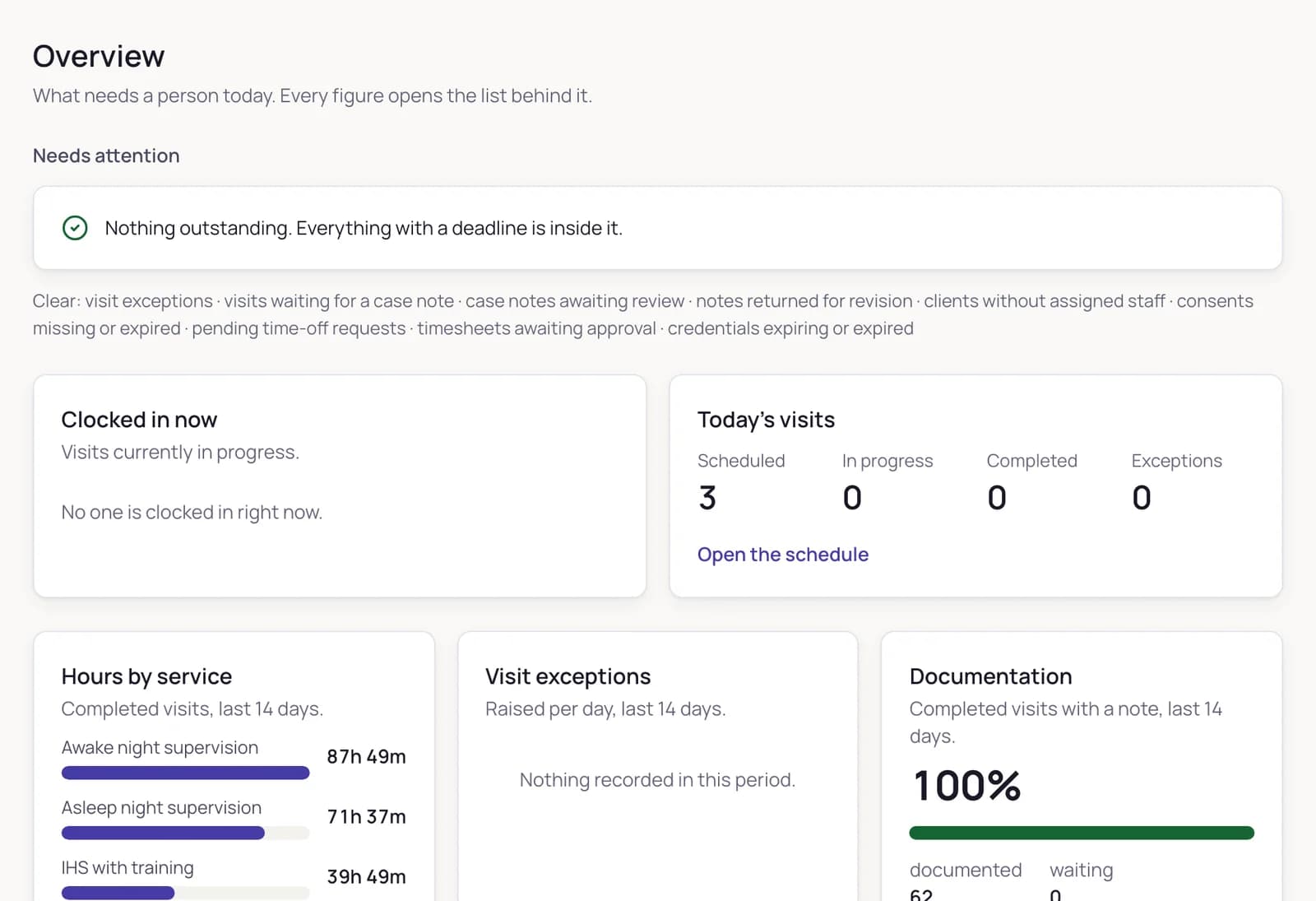
Administrator
- Full operational overview
- Client and staff management
- Assignment controls
- Everyone's schedule
- Review queues
- Reports and audit history
- Policy settings
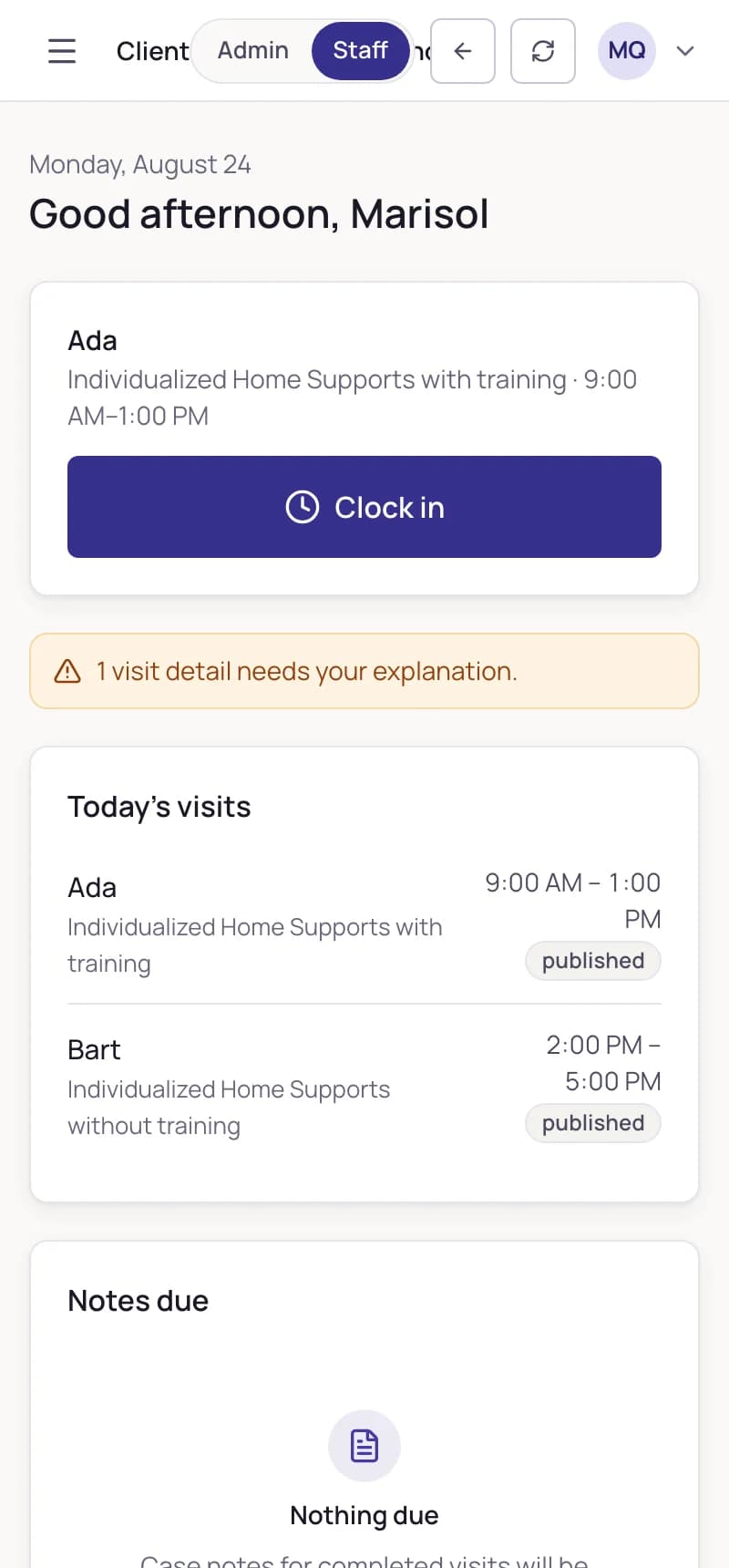
Staff
- Today's work and one-tap clocking
- Assigned clients only
- Case notes and their deadlines
- Their own timesheet
- Time off and messages
Clients they are not assigned to are not listed, not searchable, and not reachable by typing the address — the denial does not even confirm the record exists.
Try it in the demo → assign a client, switch to the staff view, and watch access appear. Then take it away.
The modules03
Eight answers to “does it do…”
Nineteen modules in the product; these are the eight a walkthrough always turns on. Each one is in the interactive demo, working.
Client records
Identity, services, support plans, goals with method and measure, progress entries, contacts and guardians, documents, consents with expiry, disclosure logs, signature documents and incidents. Eleven tabs, each its own access surface.
Assignments
Primary, backup and temporary, with end dates that expire on their own. The assignment is the access: make it and the staff member can reach the record, end it and they cannot. Drag and drop, or a keyboard control that does the same thing.
Scheduling
Draft and publish shifts. Non-client work is scheduled the same way, without inventing a client to book it against. Overnight, community and remote services are first-class.
Visits and EVV
Clock in and out with location captured at those two moments only. Exceptions for late clock-ins, missing clock-outs, locations outside the expected area and low accuracy. Services that do not require verification show as not applicable rather than as failures.
Documentation
Case notes with a real lifecycle: draft, submitted, returned with a reason, approved and locked. A locked note is never edited — corrections are addenda that leave the original exactly as written. Documentation periods close one-way and list what is still outstanding.
Time
Clocking out writes the time entry, so hours are a consequence of the work rather than a second thing to remember. Corrections keep the original. Reviewers cannot approve their own timesheets. Pay periods lock.
Compliance
Record requests with due dates, disclosure logs, reports that run from live records, exports written to the audit log, and an append-only history of who did what to which record.
Configuration
Geofence distance, note deadlines, period lengths and anchors, invitation expiry, staff two-factor policy, document visibility defaults, and how long to wait before closing a forgotten clock-out. Set per agency.
On the record04
Screens from the demo, not a design file.
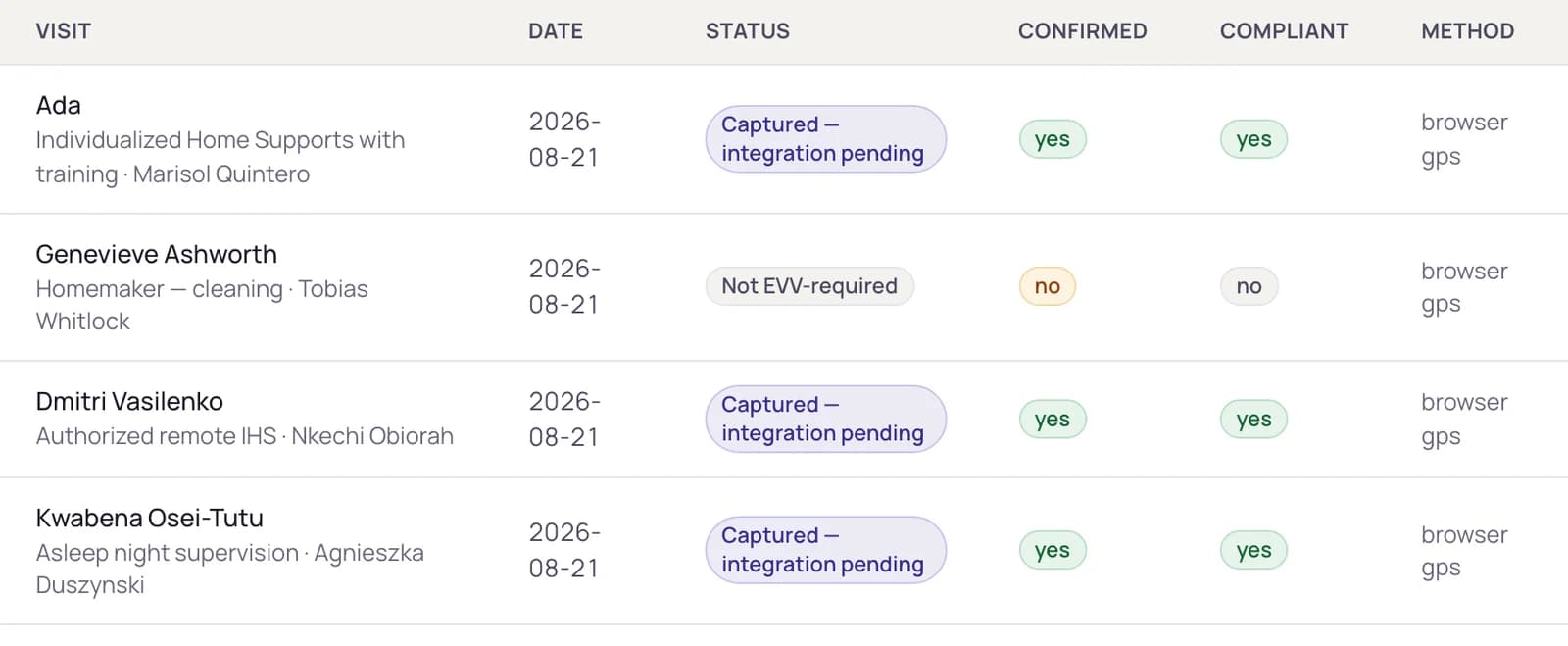
Visits, verified. Every clock event carries its evidence — and a service with no EVV requirement says not applicable, never failed.
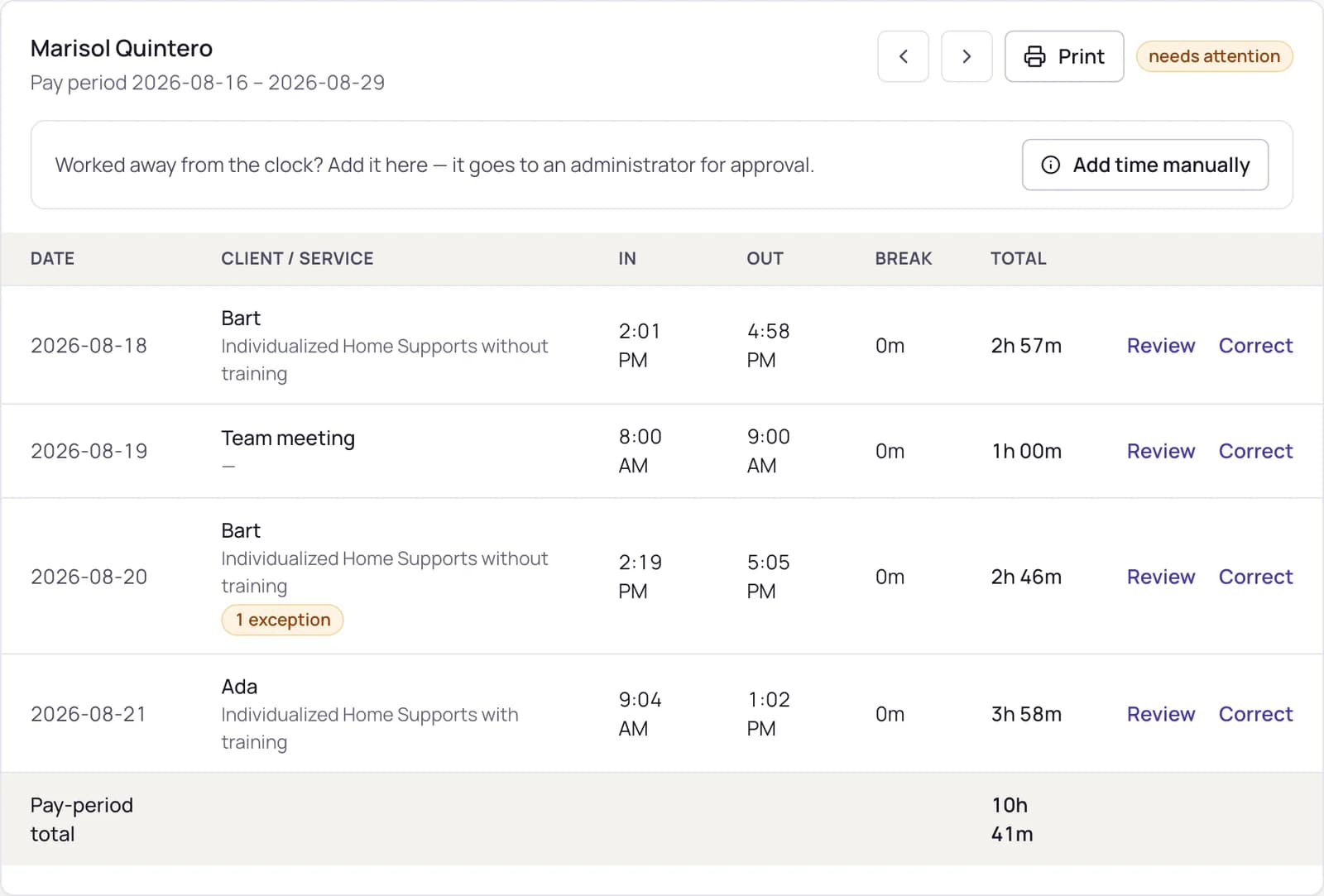
Hours as a consequence. The timesheet is written by the clock-out, reviewed by somebody who is not its owner, and locked by the pay period.