States · Texas
From initial license to initial survey, as one operation.
A newly licensed Texas home and community support services agency has six months from the effective date of its initial license to admit a client, provide services, and tell HHSC it is ready to be surveyed. Personal Assistance Services agencies that bill Medicaid also inherit the state's EVV Usage Score. ClientCentric is where the schedule, the visit evidence, the care notes, and the payroll-ready hours live as one record set — configured for your agency, never assumed.
The six-month window, and what the initial survey looks for
The initial license is where the clock starts, not where the work ends. HHSC’s own pre-survey training puts it plainly: admit at least one client and initiate services within six months, and submit the written request for an initial survey — Form 2020 — to the designated regional survey office no later than six months after the license’s effective date. Miss it and HHSC may propose to suspend or revoke the initial license. Surveyors then review client records, personnel files, agency records, and policies across every service category you are licensed for. For a Personal Assistance Services agency that means the first client’s record has to be complete from the day of admission, not reconstructed the week before the survey.
- Deadline: admit and serve a client and submit Form 2020 within six months of the initial license's effective date — HHSC Form 2020 instructions, citing 26 TAC §558.521(b); HHSC Provider Letter 2021-18
- Consequence: failing to request the initial survey lets HHSC propose to suspend or revoke the initial license — HHSC HCSSA pre-survey training
- What is reviewed: client records, personnel files, agency records, and policies, sampled across the services on your license
- After the initial survey: agencies are re-surveyed within 18 months and then at least every 36 months; the initial license itself runs three years from issuance
- PAS-only applicants must verify that the administrator and alternate administrator completed HHSC's pre-survey computer-based training
Texas EVV: the 80% Usage Score, and what actually stops payment
If your agency bills Medicaid for personal care services, EVV has applied since January 1, 2021; home health care services followed on January 1, 2024. Since October 1, 2023 the state-provided EVV vendor system is HHAeXchange, and visits flow from it — or from an HHSC-approved EVV proprietary system — into the EVV Aggregator operated by TMHP. Two numbers matter. First, the EVV Usage Score: for program providers it weights the share of visits clocked electronically rather than entered manually at 60%, and the share of exported visit transactions the Aggregator did not reject at 40%. The minimum is 80%, rounded to the nearest whole percentage, every state fiscal quarter. Second, claims matching: a payer does not pay an EVV claim unless an accepted visit transaction in the Aggregator matches the claim line item.
- Below 80% in a quarter, first occurrence within 24 months: additional EVV training required within 20 business days of the noncompliance notice
- Second occurrence within 24 months: a corrective action plan due within 10 business days of the notice
- Third occurrence within 24 months: the payer may initiate contract termination
- Separately, payers may temporarily withhold Medicaid claim payments over landline phone verification failures until compliance is met
- Claims: no accepted EVV visit transaction in the Aggregator, no payment on that claim line
Sources: HHSC EVV Compliance Job Aid for Program Providers and FMSAs (revised March 2024), which references EVV Policy Handbook sections 10010 and 16000; HHSC EVV Policy Handbook section 12000 (usage) and the EVV pages at hhs.texas.gov; TMHP EVV Aggregator and EVV Portal documentation.
The operational lesson is that manual visit entries and rejected transactions are the two things that erode the score. The schedule, the client and staff identifiers, and the clock-in evidence have to agree before a visit is ever exported — which is a records problem long before it is a compliance problem.
One operations system for the survey's documentation asks
The initial survey and the EVV review pull on the same records from different directions. A surveyor wants to see that the client was admitted properly, that the people serving them were cleared and assigned, that services delivered match the plan, and that the notes hold up. The EVV review wants every one of those visits clocked, matched, and exported clean. ClientCentric keeps them as one record set:
- Scheduling: a month calendar with draft-and-publish, so visits are planned against the client's services and the assigned staff — the schedule is what the visit is checked against
- EVV evidence: clock-in and clock-out with location captured at those two moments only, exceptions queued for review, and compliance computed over required visits — services that do not require verification show as not applicable
- Care notes: a locked lifecycle with corrections that preserve the original, so the note a surveyor reads is the note that was written
- Payroll-ready hours: timesheets generated from the same clock events, with missed clock-outs and mid-week overtime flagged before the period runs — then exported to the payroll system you already use
- Credentials and consents with expiry dates that warn before the lapse, not after
- Audit history: append-only, so record requests and exports are themselves audited events
For Texas specifically, the transmission leg — into HHAeXchange as the state vendor system or an HHSC-approved proprietary system — is configured per deployment and described as connected only after it has been verified for your agency. We do not describe an integration as live before it is.
Starting clean vs. migrating later
A launcher has one advantage no established agency gets back: an empty database. The first client record, the first personnel file, the first schedule, and the first visit can be created in the system that will hold them at survey time — no re-keying, no “we tracked that in a spreadsheet until month four.” Agencies that start on paper or a generic scheduler and migrate later pay twice: once to run the interim process and once to move it, and the move tends to land in the same months the initial survey does.
- Configure the client record, services, and staff assignments before the first admission — the survey samples exactly these
- Capture EVV evidence from the first Medicaid visit; the Usage Score is measured on each state fiscal quarter's exported visits
- Write the first care notes in the locked lifecycle, so the survey's sample is the working record rather than a reconstruction
- If you do start elsewhere, the migration pipeline is part of the product — a confidence report, written approval, and a rollback window — but starting clean is cheaper than any migration
Migration is available and accounted for; see how switching works. We still tell launchers the plain thing: the cheapest migration is the one you never need.
For established Texas agencies
An agency past its initial survey lives on the other side of the same rules: renewal surveys within 18 months and then at least every 36 months, quarterly EVV Usage reviews, and — for anyone who has already received a noncompliance notice — a 24-month window in which the next one escalates. The questions become operational: where the score erodes (manual entries or rejections), which visits generate the exceptions, and whether the notes and timesheets from six months ago would survive a records request today.
- Exception review as a queue, not a spreadsheet: every missed clock-out and rejected visit attributable to a client, a staff member, and a fix
- Timesheets and billing-ready visits built from the same evidence, so payroll and claims stop disagreeing about the same hour
- Switching with history intact: clients, assignments, notes, visits, and audit trail migrated with a confidence report and a rollback window
- Assignment-based access, so a growing roster does not mean everyone sees everything
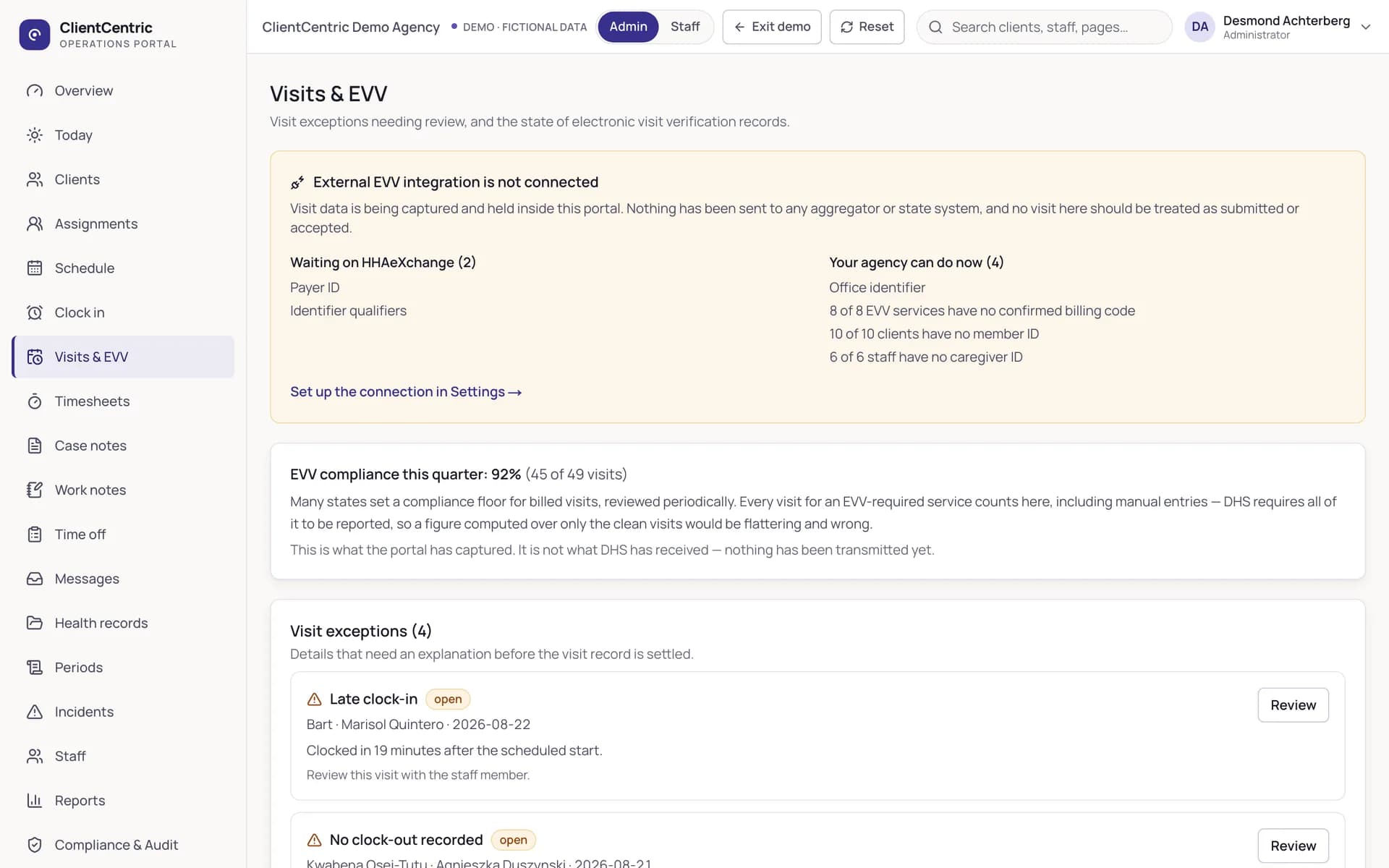
The two things that erode a Usage Score, as a queue. Manual entries and rejected visits appear as reviewable exception cards with their evidence; the compliance figure counts required visits only, and every count opens its list.
Honest status lines
- State configuration pack: Texas is configured deliberately per agency at onboarding — not yet a preconfigured pack like Minnesota 245D
- EVV evidence capture: available in product
- Texas EVV transmission (HHAeXchange or an HHSC-approved proprietary system): configured per deployment; described as connected only after verification for your agency
- Migration: available — the pipeline is part of the product
- Payroll and claims submission: hours and billing-ready visits export to the systems you already run; ClientCentric is not a payroll company or a clearinghouse
Program references: Texas Health and Safety Code Chapter 142; 26 Texas Administrative Code Chapter 558; HHSC Form 2020, Notification of Readiness for Initial Survey; HHSC Provider Letter 2021-18; the HHSC HCSSA pre-survey computer-based training; the HHSC Electronic Visit Verification Policy Handbook and EVV Compliance Job Aid; TMHP EVV Aggregator and EVV Portal documentation. Verified against those publications on 2026-09-03. This page describes software configuration, not legal advice; licensing and EVV obligations remain the agency’s own.
Keep reading
- Home care agenciesThe schedule, the visit, and the timesheet as the same fact.
- EVV workflowsEvidence, exceptions, and compliance over required visits only.
- Payroll-ready hoursThe period computed from the hours the visits wrote.
- Billing-ready visitsWhat has to be true before a visit can bill.
- SwitchingMoving an agency's history in, accounted for.
- Minnesota 245DThe preconfigured state configuration.
Written and maintained by the ClientCentric team from the working product. Last reviewed . Texas is configured per agency; the rules on this page were verified against HHSC and TMHP publications on 2026-09-03.